 Skip to content
June 8th, 2026 | 10:29 PM | 22:29
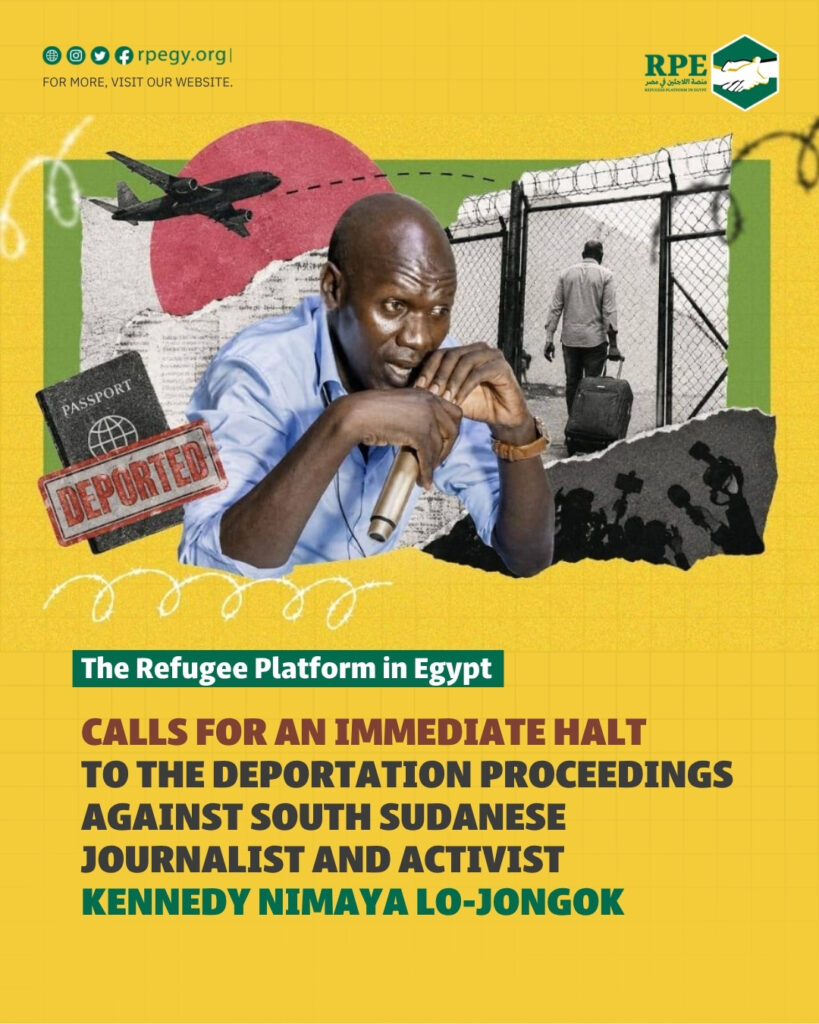
On April 29th, 2026, Egyptian authorities arrested Kennedy Nimaya Lo-Jongok, a writer, journalist, and leader of the opposition National Salvation Front in South Sudan, as he was on his way to work, according to his family. Kennedy Nimaya Lo-Jongok has remained in detention since that date despite having recognized legal status as a refugee registered with the United Nations High Commissioner for Refugees (UNHCR) in Egypt.
In the weeks following Kennedy Nimaya Lo-Jongok’s detention, concerns about his welfare escalated amid recurring reports of attempts to deport him to South Sudan. His family also reported that Kennedy was scheduled to be deported as part of a group of detained people last May, before those proceedings were halted. These developments raise grave concerns given his political dissension activism and the severe risks to his freedom and personal safety that Kennedy’s return to his country of origin would entail.
On May 21st, 2026, the Executive Regulations of the Law on Asylum for Foreigners, issued by Prime Ministerial Decree No. 1568 of 2026, were published in the Official Gazette. Article 2 of the implementing regulations explicitly stipulates that refugee and asylum-seeker cards issued by the United Nations High Commissioner for Refugees (UNHCR) prior to the entry into force of the regulations shall remain valid until their expiration or until alternative documents are issued by the Relevant Committee for Refugee Affairs.
According to information obtained by RPEGY, Kennedy Nimaya Lo-Jongok is 41 years old, the patriarch of a family of three, a journalist, writer, and leader of the opposition National Salvation Front in South Sudan. Kennedy arrived in Egypt in 2019 and registered with the United Nations High Commissioner for Refugees (UNHCR) that same year. Kennedy also holds a blue refugee card issued by the UNHCR, which confirms his status as a refugee and expires in 2027.
The Refugee Platform in Egypt asserts that the continued detention of forcibly displaced South Sudanese citizen and refugee Kennedy Nimaya Lo-Jongok to date, despite the clarity of his legal status and his entitlement to international protection, begs serious questions regarding the extent to which Egyptian security authorities are committed to the legal framework governing asylum matters. Kennedy’s detention comes within the broader context of an unprecedented security crackdown Egypt has witnessed since the beginning of the year. RPEGY has documented the detention and deportation of thousands of forcibly displaced people, including forcibly displaced South Sudanese citizens, some of whom are registered as refugees or asylum seekers with the UNHCR.
Kennedy’s detention reinforces the concerns previously expressed by RPEGY regarding the legislative ambiguity resulting from the enactment of a legally flawed asylum law, followed by implementing regulations that violate international standards and are incomplete. This legislative ambiguity has led to institutional uncertainty through which the Interior Ministry and security agencies exercise discretionary powers. These discretionary powers include prolonged administrative detention of forcibly displaced people as well as forced deportation, and do not allow individuals to challenge these decisions before the courts. Individuals are not provided with copies of these administrative decisions and are sometimes forced to sign voluntary return documents.
The challenges facing Egypt’s asylum system are not limited to legislative shortcomings and flaws; they extend to implementation and material levels, whether under the old asylum system that remains in force today both legislatively and judicially, or under the new asylum system which has not yet been defined or finalized. This constitutes the practice of a ‘hybrid condition’, as the flawed Asylum Law and its security-oriented execution regulations, which violate protection guarantees, only obtain tangibility from the extent to which the relevant authorities are committed to implementing these regulations while respecting the safeguards they involve. As for the continued detention of people who are supposed to be entitled to legal protection (under both the old and new asylum systems), this contention raises serious concerns regarding the effectiveness of protection guarantees and their implementation practically, and raises questions regarding the compatibility of security practices with the stated objectives of the new legislative framework. A framework that is supposed to provide the protection of forcibly displaced people fleeing conflict and persecution must not expose them to additional risks or deprive them of those guarantees. This contention also reinforces concerns regarding the rushed transitional phase the Egyptian government is attempting to undertake without being politically or institutionally prepared for it.
Kennedy’s detention is reminiscent of the deportation of forcibly displaced Sudanese citizen and journalist Omar Ibrahim ‘Henry’ who fled the war in Sudan twice, first to Kampala and then to Cairo, but was deported by Egyptian authorities to his homeland last March. Omar Ibrahim ‘Henry’’s deportation took place despite the risks associated with the destabilizing violence and armed conflict that have been ongoing in Sudan since April 2023.
RPEGY has previously published part of the testimony of forcibly displaced Sudanese citizen, novelist, and short-story writer Idris Ali Babiker, who was arrested by Egyptian authorities in the al-Marg district of eastern Cairo in late February as part of a crackdown targeting a number of asylum seekers. Idris Ali Babiker was held at al-Khanka Prison along with ‘thirty people in a cell measuring four by four meters, with an indoor bathroom. We drank water from the only faucet there. In Banha Prison, there were seventy of us in a room measuring ten by five meters with an indoor bathroom’, according to Idris Ali Babiker’s testimony.
RPEGY calls on the Egyptian authorities to immediately release Kennedy Nimaya Lo-Jongok; to immediately halt any proceedings that could lead to his forced deportation; and to ensure Kennedy receives all the rights and protections afforded to refugees and asylum seekers under Egyptian law and relevant international obligations.
RPEGY also calls on the United Nations High Commissioner for Refugees (UNHCR) to intensify its legal efforts, urgently follow up on Kennedy’s case, take necessary action to protect Kennedy, and ensure he is not subjected to forced return.
The Refugee Platform in Egypt urges human rights organizations and the mainstream media to continue following Kennedy’s case and standing in solidarity with Kennedy, thereby contributing to his protection and ensuring the respect of his fundamental rights.
RPEGY affirms that we will continue to monitor Kennedy’s case; take any necessary legal, advocacy steps to defend Kennedy’s right to liberty and protection from forced return; as well as ensure respect for the rights guaranteed to refugees and asylum seekers in Egypt.