 Skip to content
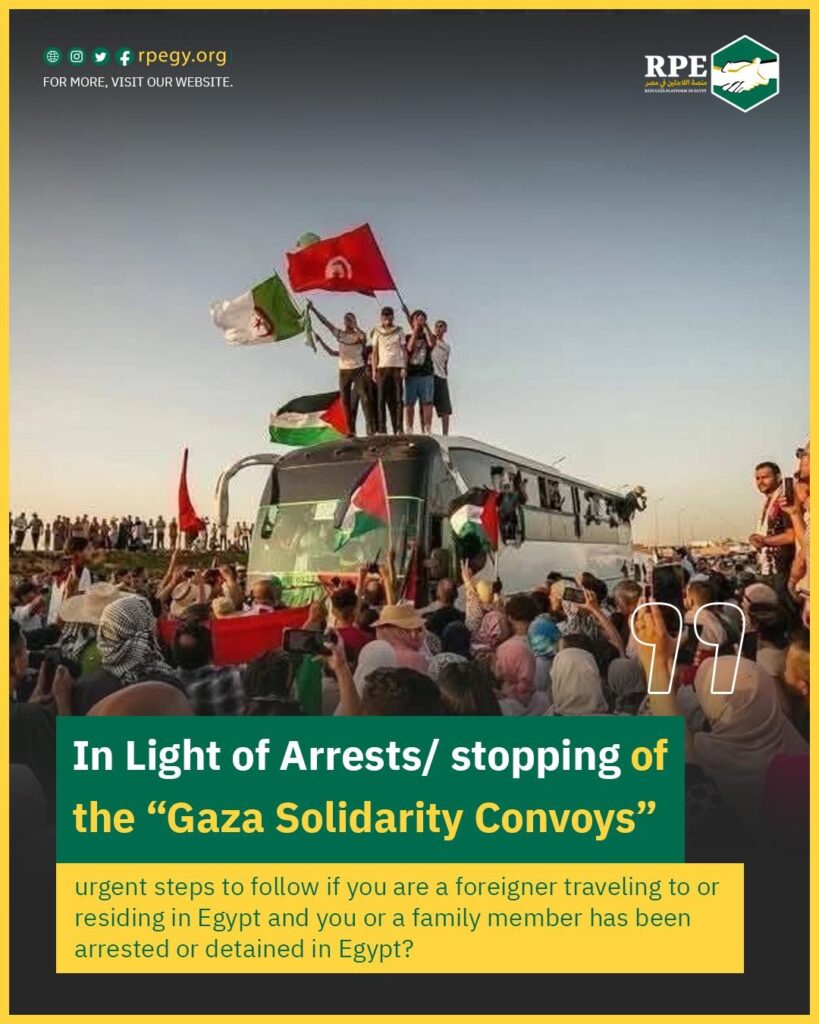
In light of the ongoing arrests and detentions documented by The Refugees Platform in Egypt since yesterday — following calls to participate in Arab and international convoys in support of Gaza — dozens of individuals, both involved and uninvolved in the convoys, have been affected. These include foreign nationals from Arab and European countries, whether upon entering Egypt or during their stay.
Recent reports have indicated the arrest and deportation of European nationals from Cairo. This began with statements by Catherine Le Scoullan-Keery, spokesperson for the French delegation that arrived in Egypt to join the “Global March to Gaza,” who confirmed that Egyptian authorities detained several French citizens upon arrival at Cairo Airport, while others were targeted at their hotels in downtown Cairo.
Based on alerts and legal consultation requests received by The Refugees Platform in Egypt, as well as statements from convoy organizers, over 200 foreign activists — both Arab and European — have been detained. Some were released after short-term detention, others were deported, while communication remains cut off with several detainees.
In response to these rapidly unfolding developments — which include detentions of solidarity convoy participants and other foreign visitors in Egypt — we present the following security recommendations to all foreign travelers and participants in Gaza solidarity efforts:
Security Guidelines to Avoid Arrest or Detention in Egypt:
- Always carry your passport, visa, and residency permit (if applicable), both while at your residence and when traveling.
- Ensure your visa is valid prior to travel, especially if you require a pre-arrival visa to enter Egypt.
- Keep both physical and digital copies of your documents stored securely.
- Save the contact numbers of your embassy/consulate in Cairo, as well as trusted family or friends, on your phone and on a physical note — you may lose access to your device during detention.
- Inform your contacts of your stay in Egypt, including your location and purpose.
- Contact your embassy immediately in case of arrest or interrogation, and request legal representation.
- Share your accommodation details and daily movements with trusted persons; use live location sharing when possible.
- Deactivate your social media accounts before entering Egypt, and avoid logging into them during your stay.
- Scan your phone and delete any sensitive content (photos, messages, files) that could be misinterpreted — even apolitical material can be risky.
- Enable auto-deletion of messages in coordination groups (ideally every 5 minutes or less).
- Use a local Egyptian E-SIM to maintain stable communication.
- Avoid using devices with confidential data (such as work laptops); erase browsing history and saved passwords.
- Do not carry prohibited equipment (e.g., drones, broadcasting devices, professional cameras).
- Avoid wearing or carrying politically sensitive symbols (e.g., Palestinian flags, keffiyehs, stickers) that may trigger security scrutiny.
- Memorize your hotel/residence address, as you may be asked at the airport or during an arrest. Keep a printed copy of your accommodation booking and travel itinerary.
- Avoid walking alone, especially after midnight or near sensitive areas (e.g., borders, airports, government buildings).
What to Do If You Are Arrested or Detained in Egypt:
If you are detained or arrested, follow these steps methodically to protect yourself:
- Contact your embassy immediately and request legal representation. Inform your family or trusted contacts as well.
- Use your emergency contact note if your phone is confiscated.
- Write a secret note with your full name, nationality, place and date of detention, and a contact number. Try to pass it to a visiting lawyer or another detainee likely to be released.
- You have the right to:
- Be informed clearly of the reason for your detention.
- Contact your embassy or relatives to inform them of your detention location.
- Refuse to sign any documents without your lawyer present and without a trusted translator if you do not read Arabic.
- Request a medical examination if you are subjected to any physical harm.
- Have your lawyer and embassy representative present during interrogation.
- Refuse to answer questions or participate in interrogations — your right to remain silent.
Interrogation Strategy – Use the Following Phrases:
- “I prefer not to answer without a lawyer present.”
- “This is a political question; I am not qualified to answer it.”
- “I need a translator; Arabic is not my first language.”
- “I choose to remain silent and not answer the question.”
- “I will not unlock my phone without a court order.”
Important Notes:
- If you’re forced to unlock your phone, ensure it contains no sensitive content (images, videos, documents).
- If your phone or luggage is searched, inspect your phone afterwards to ensure no spyware or foreign files were installed.
- Carry cash, as you may be unable to use bank cards or digital payment options in certain circumstances.
For Urgent Legal Support in Egypt:
You may contact The Refugees Platform in Egypt through their Legal Aid Clinic (link here),
or reach out to local human rights organizations providing legal assistance, including:
The Egyptian Commission for Rights and Freedoms (ECRF)
WhatsApp: +20 122 054 9568
Contact numbers for embassies in Egypt (from the official websites):
| Phone/ WhatsApp | Embassy | ||
| at.caire@diplomatie.gov.tn |
(+20) 2 2736 8962 |
Tunisia | |
| morocemb@link.net | (+20) 2 27 35 96 77
(+20) 2 2736 48 49 |
Morrocco | |
| (+20) 2 2736 8527 / 1520
(+20) 2 2738 0363 |
Algeria | ||
| (+20) 3 494 0808
(+20) 3 494 0286 |
Libya | ||
| embassy.cairo@mfa.gov.tr | (+20) 2 279 784 00
(+20) 127 122 9555 |
Turkey | |
| +20-235673200 | France | ||
| ambasciata.cairo@esteri.it | +20 (0)2 27943194– 27943195 | Italy | |
| cairo.consular@diplobel.fed.be | +20 122 210 34 33
+20 2 279 474 95 +20 2 279 474 94 |
Belgium | |
| ambassaden.kairo@gov.se | +20 2 2728 9200 | Sweden | |
| +202 27 39 55 00
+31 857 737 400 |
Netherlands |