 Skip to content
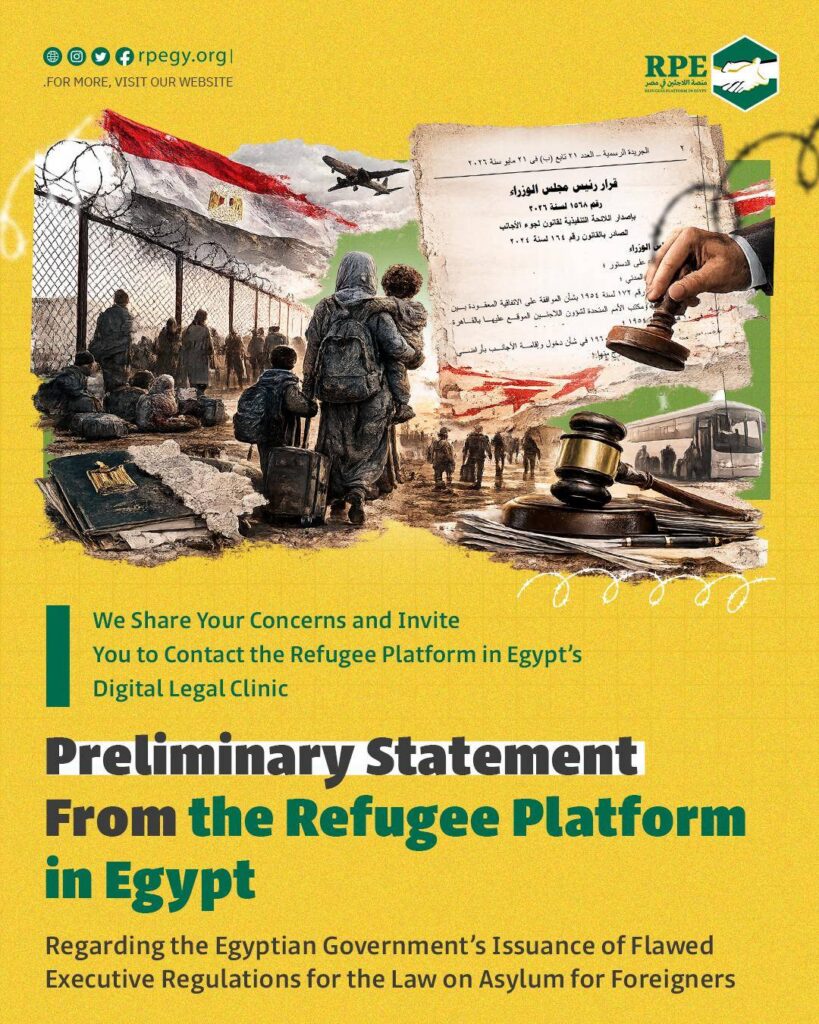
The Refugee Platform in Egypt shares the concerns and questions of forcibly displaced communities in Egypt regarding their conditions and the future of their various legal statuses, following the Prime Minister’s sudden issuance on May 21st, 2026, of Decree No. 1568 of 2026 that issued the executive regulations for the Asylum Law for Foreigners No. 164 of 2024.
The regulations were issued without any public dialogue, or the involvement of key stakeholders, specialized experts, or organizations working in the field of asylum and protection, foremost among them the UNHCR in Cairo that has managed, and continues to manage, the asylum system in Egypt for decades. Nonetheless, the UNHCR in Cairo was not consulted in the drafting of the regulations, and its previously expressed comments on the law itself were disregarded.
The law also completely ignored the recommendations of the UN Special Rapporteurs in their communications with the Egyptian government regarding the law, its flaws, violations, and concerns surrounding it. Furthermore, the drafters of the regulations ignored the comments raised by UNHCR regarding the law itself.
These implementing regulations reproduce the fundamental flaws that marred the Asylum Law itself; indeed, some of their provisions go so far as to impose even more restrictive measures and violations of basic protection standards. Additionally, some of these regulations actively contradict provisions of Egyptian law, constitutional guarantees, and Egypt’s international obligations regarding the protection of forcibly displaced people and human rights. Like the law itself, the regulations adopt a primarily security- and administrative-based approach, without adequately addressing key protection issues and with a complete disregard for the existence of the active asylum system through which more than one million people have already registered. Meanwhile, the regulations do not provide a clear overview of the rights associated with the legal statuses granted and recognized through the already existing asylum system, or those that will be recognized through the new system.
These concerns are growing amid the uncertainty surrounding the new institutional arrangements. As of the date of this statement, the process of forming the Standing Committee for Refugee Affairs, as stipulated in the law and regulations as the committee that is supposed to receive the files of more than 1.2 million asylum seekers and applicants as well as issue decisions regarding them, has not yet been completed. Only a decision to appoint a chairperson has been issued, without an official announcement regarding the appointment of remaining members, the committee’s headquarters, its structure, its detailed operating procedures, or the standards of independence and impartiality that must govern its decisions.
In contrast, the implementing regulations impose strict and unrealistic deadlines on individuals, on the transfer of files, and on the implementation of the new system. Simultaneously, the implementation process is delegated to what it calls the ‘specialized subcommittee’ for which no decisions have yet been issued regarding its formation or the definition and scope of its powers. Furthermore, no discussion regarding the case management system has been held with the ‘ministries and relevant authorities’.
While legal experts and researchers at RPEGY continue to study the regulations issued by the Egyptian government, we reiterate that the Asylum Law, which was enacted despite its legislative flaws; its violations of constitutional; and international obligations, and the legislative ambiguity it has caused in the asylum system was enacted more than a year after the deadline set by the law itself. Moreover, the Asylum Law was enacted with the same legal and legislative flaws found in its draft along with additional discrepancies. All of these compounding factors led to ambiguity in Egypt’s asylum legal framework and resulted in the collapse of the protection system.
The implementing regulations have entrenched these legal flaws, which were warned against by special rapporteurs of the United Nations and human rights organizations concerned with forcibly displaced people’s rights, in the law.
The most significant of which are:
- The institutional nature of the committee, which undermines its independence and impartiality.
- The persistence of fundamental human rights risks associated with violations of the existing laws, philosophies, regulations, and standards of international conventions, including a punitive approach to unlawful entry and the criminalization of shelter and employment outside of security frameworks.
- Provisional measures that go beyond what is necessary and lack effective judicial oversight, through a broad authority to impose severe restrictions on asylum seekers’ movement and residence.
- The creation of a biometric database raises legitimate concerns regarding privacy, the purposes for which the data will be used, and the policies governing its use.
- The use of vague terminology, particularly in defining the jurisdiction of the ‘relevant ministry’ and the limits of that jurisdiction, exacerbates concerns regarding the relationship between decisions to deny or revoke refugee status and the powers of expulsion and deportation.
These and other significant concerns, which threaten to turn legislative ambiguity into institutional ambiguity, will undermine what remains of Egypt’s existing asylum system without any genuine or transparent groundwork laid for the new system.
A preliminary reading of the implementing regulations makes it clear that the main concerns associated with the ‘transitional phase’ between the old asylum system, which has been active and under UNHCR jurisdiction for decades until now, and the new national system remain very much alive. The regulations did not clarify the criteria, policies, and procedures for managing this transitional phase, nor did they provide a clear vision for the future legal status of those registered with UNHCR. The regulations merely noted the validity of certain cards issued without addressing all documents and records active under the existing system. This aspect alone raises grave questions regarding the stability of the legal status of more than one million people registered with UNHCR. Moreover, the regulations did not clearly address the conditions of forcibly displaced people in the context of mass and repeated forced displacement driven by fear and flight from major humanitarian disasters, for example the current circumstances of forcibly displaced people from Sudan, despite the specific nature of their conditions and protection needs, nor did they clarify data protection policies.
Accordingly, RPEGY’s Legal Unit is currently conducting a detailed examination and review of the implementing regulations, and analyzing the extent to which its provisions align with the Foreigners’ Asylum Law itself as well as the Egyptian Constitution and Egypt’s obligations under international refugee and human rights law. This is being done in preparation for issuing a comprehensive legal assessment that clarifies the key provisions of the regulations and the potential implications of their implementation on the circumstances of refugees and asylum seekers.
As of the publication of this statement, the United Nations High Commissioner for Refugees (UNHCR) in Egypt has not issued any official statements or clarifications regarding the implementing regulations or the transitional arrangements. The Refugee Platform in Egypt emphasizes that the registration process continues to be conducted through UNHCR, in accordance with the existing system, with no announced changes to date; and that the executive regulations will not enter into force until three months after their issuance. This includes the transitional arrangements the implementing regulations stipulate, arrangements that RPEGY regards as seriously flawed in terms of their timing, unreasonableness, insufficient safeguards, and lack of clarity.
As a result, RPEGY, on behalf of forcibly displaced communities in Egypt, demands that the United Nations High Commissioner for Refugees (UNHCR) issue an urgent official clarification regarding the current legal status; the procedures expected during the transitional period; and the impact of the entry into force of the implementing regulations on the circumstances of refugees and asylum seekers, including forcibly displaced people still in the early stages of registration with UNHCR.
RPEGY also demands the clarification of the policies that will govern the transfer of files, as well as any related restrictions or safeguards regarding confidential files specifically, and for a clear timeline for the transition from the existing registration system to the new national system. RPEGY also demands clarification on the UNHCR’s role in preparing for this transition, as well as its legal opinion and comments on the implementing regulations.
Lastly, RPGEY cannot emphasize enough the importance of obtaining information from reliable sources during this critical phase and avoiding reliance on rumors or unverified information circulating regarding the executive regulations or their implementation procedures, which have not yet begun. Misinformation risks fueling anxiety and tension among forcibly displaced communities at a time when they are in dire need of clarity and reassurance. RPGEY is committed to providing additional clarifications as well as updates, and to issuing a detailed legal analysis of the legal provisions within the implementing regulations and their practical implications as soon as the ongoing legal examination is completed.
Until the legal study is completed and a detailed legal opinion is issued by RPEGY’s experts, the platform welcomes all inquiries, questions, and comments regarding the implementing regulations and their impact on the conditions forcibly displaced people face.
You can contact RPEGY’s digital legal clinic to access available legal information and submit inquiries via the link (here).
You can also refer to relevant legal texts, documents, and studies via the following links:
To view the implementing regulations: Please click on the link (here).
To view the Foreigners’ Asylum Law No. 164 of 2024: Please click on the link (here).
To view the Prime Minister’s decision regarding the appointment of the Chair of the Permanent Committee for Refugee Affairs: Please click on the link (here).
You can also view related Egyptian laws through the Legal Library on Migration and Asylum: Please click on the link (here).
To view the legal examination of the Asylum Law: Please click on the link (here).
To view a policy brief on the draft Foreigners’ Asylum Law:
Please click on the link (here).
To view comments from the United Nations High Commissioner for Refugees: Please click on the link (here).
To view the UN Human Rights Council special rapporteurs’ statement addressing the Egyptian government regarding the Asylum Law: Please click on the link (here).