 Skip to content
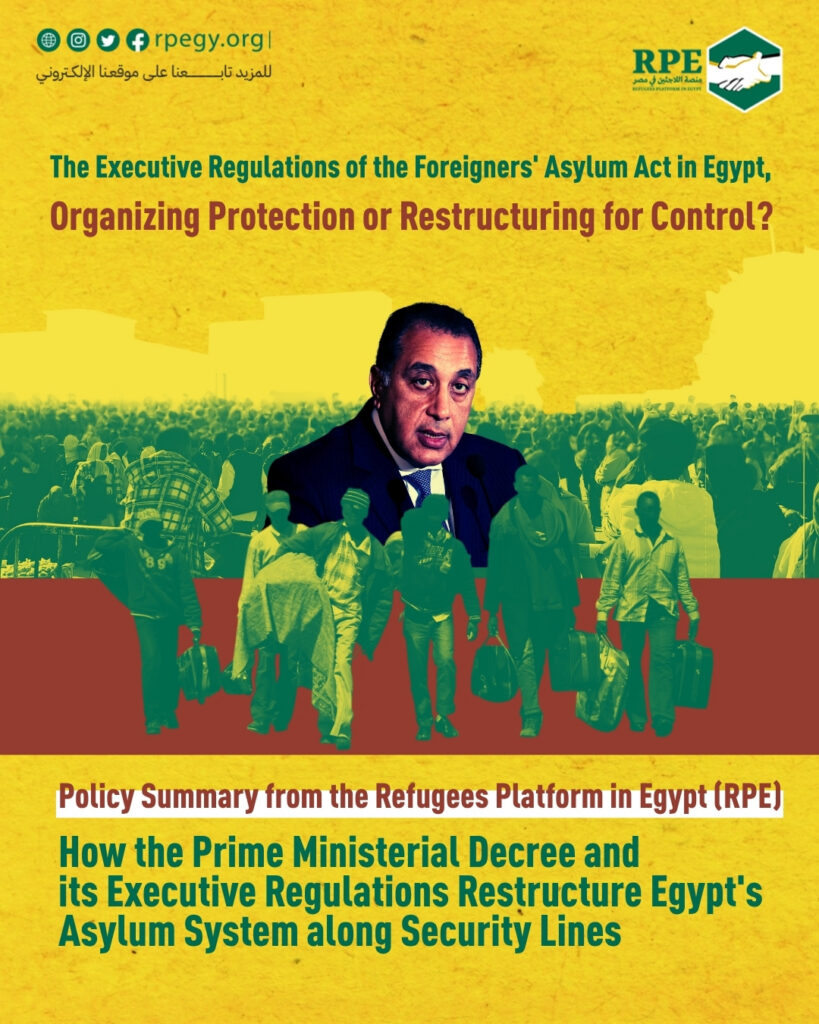
The Refugees Platform in Egypt has released a new policy paper titled ‘From Legalizing Ambiguity to Undermining Protection: How the Prime Minister’s Decision and Its Implementing Regulations Restructure the Asylum System in Egypt Along Security Lines’ that provides a legal and human rights assessment of the implementing regulations issued by Prime Ministerial Decree No. 1568 of 2026, which governs the implementation of the Foreigners’ Asylum Law No. 164 of 2024. In the policy paper, RPEGY demands a postponement of the effective implementation of the Foreigners’ Asylum Law and its implementing regulations until the legal and procedural issues raised regarding them are addressed.
The policy paper concludes that the implementing regulations, rather than addressing the shortcomings in the law, have entrenched most of its issues and even exacerbated their effects. This entrenchment therefore reshapes Egypt’s asylum system in a manner that weakens the independence of the relevant authority, undermines procedural safeguards, threatens existing legal statuses, and restricts effective access to international protection. Additionally, these clawbacks are in direct violation of the Egyptian Constitution and Egypt’s international obligations, foremost among which is the principle of non-refoulement.
This policy paper emphasizes that the existence of a national asylum framework is not objectionable in and of itself; rather, the efficacy of any national system is measured by the system’s ability to provide complete, independent, and fair protection to people fleeing persecution and conflict, while striking a balance between national security considerations and human rights obligations. Nonetheless, according to the analysis, the new system clearly tends to prioritize security and administrative considerations over the philosophy of protection.
The policy paper notes that the law and its implementing regulations were drafted amid an almost complete lack of public consultation, with the United Nations High Commissioner for Refugees, civil society organizations, legal experts, and forcibly displaced people themselves excluded from the drafting process. This lack took place despite the long delay in issuing the implementing regulations, where the regulations drafted undermined the legitimacy of the legislative reform process and reduced the chances of addressing the shortcomings highlighted by human rights and international organizations.
The policy paper also explains that one of the most significant problems raised by the implementing regulations is the granting of broad discretionary powers to the Standing Committee for Refugee Affairs based on vague and undefined concepts such as ‘national security’, ‘exceptional circumstances’, and ‘societal values’. This granting was done without providing clear definitions or criteria specifying how these concepts are to be applied, thereby opening the door to divergent interpretations and undermining the principle of legal certainty.
The policy paper additionally warns that the new institutional structure lacks safeguards for independence, as the Standing Committee was established within the executive branch with prominent representation from the Interior Ministry. The new institutional structure also does not contain sufficient guarantees for its technical or functional independence, or involve the presence of independent expertise in the field of international protection. Moreover, the committee combines the powers of registration, data collection, adjudication of applications, and oversight, raising serious concerns about the impartiality of the decision-making process and the lack of functional separation.
The policy paper pays particular attention to the transition from the asylum management system administered by the UNHCR to the new national system, noting that the regulations do not provide sufficient guarantees for the continued legal protection of refugees and asylum seekers who are already registered. The transition also did not clearly specify how case files and legal statuses would be transferred, which could leave thousands of people in a legal limbo or facing difficulties in accessing services and protection during the transition period.
The policy paper also notes that the regulation imposes procedural restrictions that could, in practice, become obstacles preventing access to protection, including setting a short deadline for some asylum seekers to submit their applications. Furthermore, the regulation also enables the automatic withdrawal of an application in various cases related to administrative procedures, with a lack of adequate safeguards that take into account the circumstances of the vulnerable subgroups.
With regard to protection against forced return, the policy paper notes that the law and the regulation limit explicit protection from deportation or extradition to those who have already been granted refugee status. The policy paper also notes that the law and the regulation do not provide clear protection for asylum seekers during the application review, appeal, or challenge stages, thereby creating a legal gap that may expose individuals in need of protection to the risk of removal before a final decision is made on their applications.
The policy paper also criticizes the weakness of procedural safeguards, noting that the regulations do not guarantee the right to legal assistance as a fundamental right, nor do they adequately regulate the right to have a lawyer present during personal interviews or to review the case file. This criticism also details the absence of provisions ensuring that a judicial appeal leads to a suspension of enforcement of deportation decisions, as that limits the effectiveness of the right to a fair trial.
The policy paper additionally addresses the measures restricting liberty permitted by the regulations, such as the imposition of residence within a specific geographical area or the obligation to report periodically. The paper specifically notes that these measures grant the administration overarching powers without sufficient judicial oversight or controls, which may infringe upon personal liberty and freedom of movement.
The paper concludes by emphasizing that a successful transition to a national asylum system requires a review of several key provisions in the implementing regulations to ensure the independence of the relevant authority; the continuation of existing legal protections; the strengthening of procedural safeguards; and the protection of all asylum seekers from forced return. This emphasis is not only integral but also would thereby ensure compliance with the Egyptian Constitution and international obligations; while also guaranteeing the establishment of an asylum system that is based on civil rights and the rule of law instead of on security and bureaucratic control.
The Refugees Platform in Egypt recommends postponing the effective implementation of the Law on Foreign Asylum and its Executive Regulations until the legal and procedural concerns they raise have been addressed through an inclusive consultation process involving civil society organizations, refugee communities, and independent experts. Such a process should ensure that the new asylum framework is aligned with Egypt’s constitutional and international obligations while allowing sufficient time to establish the institutional and operational capacity required for implementation without compromising protection safeguards.
The Platform further calls for ensuring the institutional independence of the asylum system from law enforcement and migration control authorities, safeguarding the continuity of refugees’ legal status throughout the transitional period without any protection gaps, and strengthening procedural safeguards, including the right to an effective appeal, access to legal assistance, and the suspension of removal decisions until all appeals have been finally determined.
It also emphasizes the need to subject the asylum system to robust standards of transparency, accountability, and data protection, including a prohibition on the sharing of personal information where doing so could place individuals at risk. Finally, it calls for the explicit incorporation of the principle of non-refoulement and for ensuring that no removal or deportation decision is carried out until all available avenues of appeal have been fully exhausted.