 Skip to content
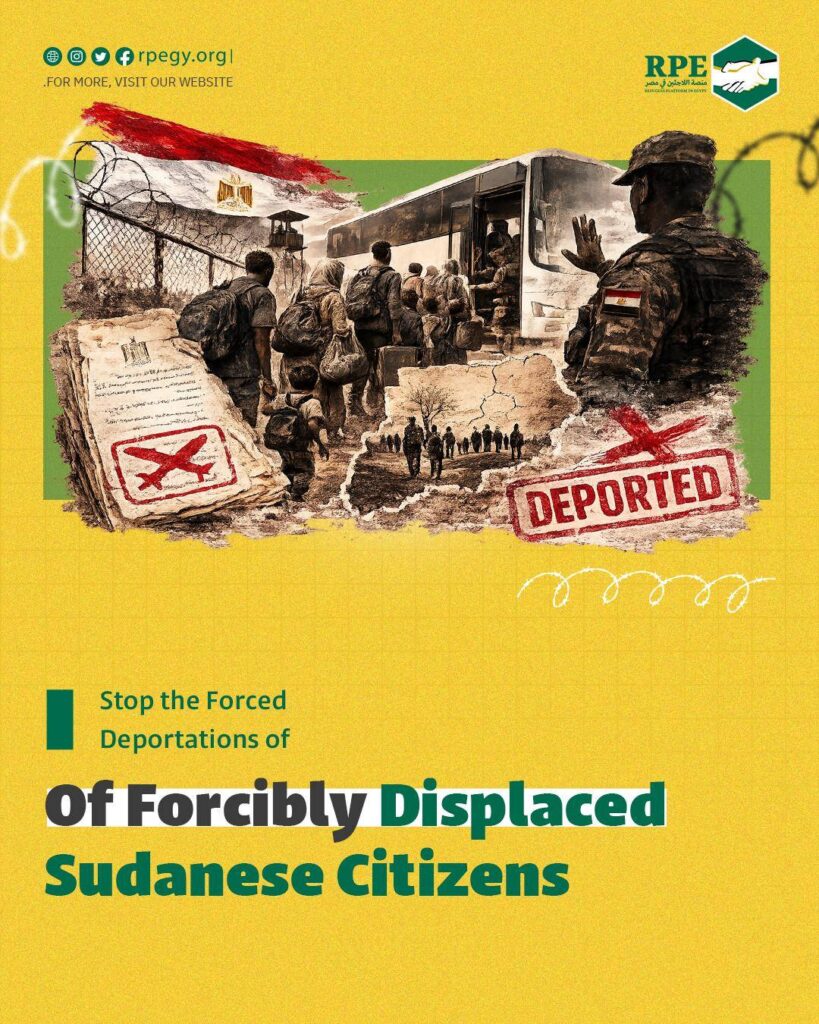
The Refugee Platform in Egypt has been following, and continues to follow, with deep concern and regret the sharp deterioration in the conditions of those fleeing the hell of the ongoing proxy war in Sudan, who continue to face horrific tragedies since the outbreak of the destabilizing violence. Instead of receiving protection and shelter in accordance with international conventions, thousands of forcibly displaced Sudanese citizens have become vulnerable to forced deportation and arbitrary detention measures in several countries, foremost among them the Arab Republic of Egypt, the State of Libya, and the Republic of Tunisia, in addition to violent pushbacks at European borders, of which the Greece is a glaring example.
Making Sudanese citizens return to a country currently classified as an area of destabilizing violence, whether through forced deportation or through denial of entry and criminalization, constitutes a flagrant violation of the principle of non-refoulement. This principle is a cornerstone of international refugee law and human rights law, which strictly prohibits the return of any person to a country where they may be subjected to torture, cruel treatment, or a direct threat to their life.
Over the past few months, we have followed with deep concern the increase in arrest and detention campaigns targeting forcibly displaced Sudanese citizens. These crackdowns include forced deportation across the southern border thereby eliminating any possibility to reach the Office of the United Nations High Commissioner for Refugees (UNHCR) to register, which deprives forcibly displaced people of legal protection and puts their lives in imminent danger. Over the past few months, the Refugee Platform in Egypt has documented these violations, which resulted in 12 deaths in detention prior to the forced deportation of forcibly displaced Sudanese citizens since the beginning of 2026. RPEGY has closely monitored numerous cases involving forcibly displaced Sudanese citizens, the details of which illustrate the blatant mistreatment of forcibly displaced Sudanese citizens in Egypt.
In a similar development, corresponding patterns of violations against forcibly displaced Sudanese citizens exist in other North African countries like Libya and Tunisia. In Libya, there have been waves of forced deportations involving hundreds of forcibly displaced Sudanese citizens, resembling the same pattern of arbitrary arrest and detention followed by forced deportation. The “Libyan government” launched what it called a national program ‘to return irregular migrants to their home countries’ in October 2025, after which accelerated measures were taken to carry out forced returns and deportations with the aim of preventing ‘any permanent settlement’ in Libya. Even before the national program was launched, there were widespread forced deportation campaigns against forcibly displaced Sudanese citizens since July 2025; in fact, the Libyan General Directorate for Combating Illegal Immigration announced on its page that it had deported 700 forcibly displaced Sudanese citizens in a single day.
The circumstances are not much different in Tunisia, where human rights reports indicate that mass expulsions of darker-skinned people have become commonplace. Tunisian authorities have deported at least 11,500 refugees and migrants to Libya and Algeria as of the end of 2025. The pace of forced deportations and what has been described as ‘mass expulsions’ of forcibly displaced people has systematically intensified since 2023, in parallel with a rise in hate speech, xenophobia and racism directed at forcibly displaced people from various African countries.
Some human rights defenders in Tunisia have described the current “voluntary” return programs as operations of ‘disguised expulsion’ resulting from ongoing violations and discrimination, which have made return the only option for forcibly displaced people. And, for some forcibly displaced people, a return to Libya even became less dangerous than staying in Tunisia.
On the other side of the Mediterranean Sea, the Greek Parliament passed a resolution to suspend the processing of asylum applications submitted by those who arrived by sea from North Africa for a period of three months, from July through October 2025. During this period, everyone who arrived in Greece was detained and, after the period ended, authorities exempted only a few groups of people from this measure, in accordance with unpublished, confidential instructions issued by the Migration and Asylum Ministry.
Although forcibly displaced Sudanese citizens were exempted as a ‘vulnerable subgroup’, they were transferred to the Malakasa Reception Center accompanied by administrative notices stating that they were required to leave Greece within 30 days. In 2025 alone, Greece pushed back at least 6,000 forcibly displaced people, both from the Mediterranean Sea and from the Evros River on the border with Turkey, as Greek authorities documented collaboration with mercenaries enabled the prevention, intimidation, beating, and robbing of forcibly displaced people at Greece’s border with Turkey. All while the Greek Coast Guard continued to push boats out to sea or sabotage their disembarkation, deliberately endangering the lives of those on board to prevent them from reaching Greece.
Based on the foregoing, and on the occasion of World Refugee Day, the Refugee Platform in Egypt demands the following:
- An immediate and complete halt to all forced deportations, expulsions, and pushbacks against forcibly displaced Sudanese citizens, as well as all forcibly displaced people in general, residing in Egypt, Libya, Tunisia, and at any European borders in accordance with the principle of non-refoulement, which is a mandatory and binding rule that must not be circumvented under any security or administrative pretext.
- Recognition of Sudan as an area of active destabilizing violence and proxy war to which no one can be returned.
- Release all individuals detained on the basis of their immigration or asylum status; end arbitrary detention; and subject any immigration-related detention to effective judicial oversight and a clear time limit, while launching an independent and transparent investigation into documented deaths in custody and ensuring accountability for them.
- Ensure that all forcibly displaced people, particularly forcibly displaced Sudanese citizens, have access to individual and fair asylum procedures, including the right to register with the United Nations High Commissioner for Refugees (UNHCR) or the legal authority responsible for registration in the host country; to legal counsel; to an effective appeal against any removal decision prior to its implementation as well as with immediate effect; and to cease using ‘voluntary return’ programs as a cover for disguised forced expulsion.
- Grant the United Nations High Commissioner for Refugees (UNHCR) and independent human rights organizations full and unconditional access to detention facilities and deportation points, and cease issuing confidential, inaccessible directives that deny specific groups protection.
- Combat hate speech, xenophobia, racism, and the systematic criminalization of forcibly displaced people, and cease linking immigration policies to security-based approaches and outsourcing deals that treat human beings as bargaining chips at the expense of their rights and dignity.