 Skip to content
May 1st, 2026 | 10:26 PM | 22:26
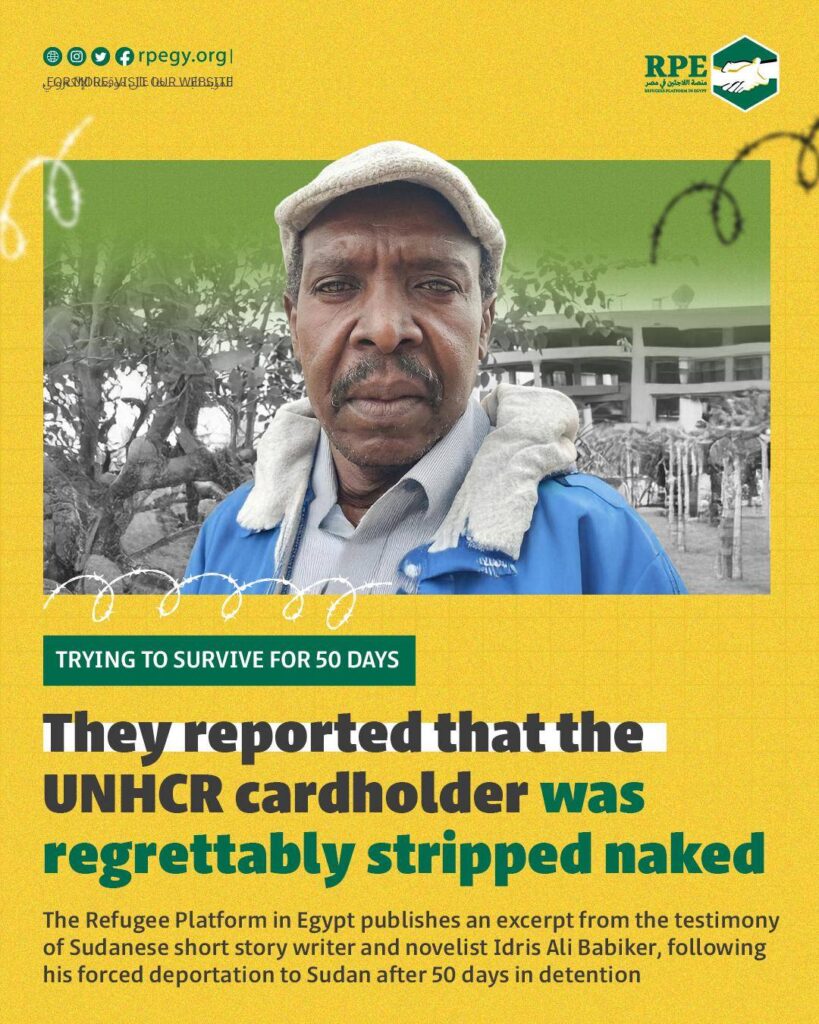
“Trying to Survive for 50 Days”
“They reported that the UNHCR cardholder was regrettably stripped naked”
The Refugee Platform in Egypt publishes an excerpt from the testimony of Sudanese short story writer and novelist Idris Ali Babiker, following his forced deportation to Sudan after 50 days in detention
Idris Ali Babiker’s Biography:
Idris Ali Babiker is a Sudanese short story writer and novelist who writes primarily from a perspective where memory, identity, and nostalgia intersect, with a clear focus on the Nubian experience, exile, and social uprooting. His short stories and novels seem to focus on the details of one’s original place and the harsh transformations that befall a person when they lose their home, language, and stability.
Notable Works
- The Old House’s Scent: A collection of contemporary short stories evoking nostalgia, childhood homes, and the past.
- Pure Blood (short story): Explores the aftermath of war and forced displacement, as well as the experience of loss and human suffering in a Sudanese context.
- ‘Anthology’: A selection of other works published on digital literary platforms.
While Sudanese novelist and short story writer Idris Ali Babiker was sketching the contours of Sudanese identity in his short story collection The Old House’s Scent, as sorrow takes flight and transcends despair in his writings, Idris was not aware that his journeying in search of safety in a neighboring country, Egypt, would end behind bars as well as take on a new form of exile that would fragment his family. The Refugee Platform in Egypt interviewed Idris Ali Babiker to document his testimony.
The testimony began with the writer’s arrest in the al-Marg neighborhood of eastern Cairo in late February 2026, as part of a crackdown targeting a number of forcibly displaced people; despite the fact that, according to reports, Idris held legal status as an applicant for international protection and was registered with the United Nations High Commissioner for Refugees.
“I would like to clarify that what the Egyptian authorities are doing does not reflect the sentiments of the brotherly Egyptian people; may God preserve the love between brotherly nations, despite the hollow barrels making futile noise”; with these words, the short story writer and novelist Idris Ali Babiker begins his testimony.
Idris continues: “I arrived in Egypt at the beginning of 2025, fleeing the hell of a destabilizing proxy war. My small family and I filed asylum applications with the UNHCR in Egypt, and we received yellow registration cards”. Idris goes on to say “I was arrested in the al-Marg area and then transferred to al-Khanka Prison where I spent a full month; where most of the people detained were Sudanese citizens. I was then transferred to Banha Prison where I was held for 20 days”.
Idris continued his testimony: “We were brought before the prosecutor’s office as suspects for not having the proper documentation. Even though most of the forcibly displaced people detained were registered with the UNHCR! Afterwards, the worst treatment we endured was from the Sudanese Embassy, which took our statements while we were handcuffed inside a police van on the street. An embassy official told us that those holding UNHCR cards and residence permits were not the embassy’s concern and that the embassy were not responsible for them, after which we were returned once again to the detention center”.
Regarding the severely inhumane detention conditions, Idris states: “In al-Khanka Prison, there were thirty of us in a cell measuring four by four meters, with an indoor bathroom. We drank water from the only faucet in the cell. In Banha Prison, there were seventy of us in a room measuring ten by five meters with an indoor bathroom”.
Regarding the harsh treatment he and other detained people faced, Babiker reports: “We were subjected to deliberate starvation; we were allowed only one meal a day, while our families were financially extorted by prison guards and police officers to bring us food. In one way or another, we were paying the monetary price for their detention of us. They ordered us to sign documents out of anger toward us and under threat, without us knowing what was written in the documentation. It was a very brutal experience, but thank God I survived it with many experiences and a long testimony to give. If I hadn’t been in prison, I wouldn’t have seen those ugly scenes or known anything about them. I am now in Sudan while my little family is in Cairo; they forcibly separated me from them!”
The detention and deportation of novelist Idris Ali Babiker comes at a time when Egypt is witnessing an unprecedented escalation in security crackdowns targeting forcibly displaced people, particularly Sudanese citizens. Since late 2025 and as of early 2026, the measures enacted have transgressed beyond being sporadic or incidental, evolving into a systematic pattern of covert forced deportation that has specifically targeted forcibly displaced Sudanese communities in a number of Egyptian governorates. The authorities’ behavior has shifted from a policy of ‘integration’ to an informal approach of ‘tightened security measures’, with security agencies launching widespread raids in residential areas where forcibly displaced Sudanese citizens are concentrated.
Human rights reports point to recurring practices accompanying this pattern, most notably: The confiscation of formal protection documents, including UNHCR cards, upon the detention of registered refugees and asylum seekers, which effectively stripped many of them of their legal status as well as allowed for the issuance of forced deportation orders outside any effective framework of international protection or safeguards against forced return and non-refoulement.
Arrest operations also expanded from border checkpoints and transit routes into city centers, through fixed and mobile checkpoints in streets, transportation hubs, residential neighborhoods, and workplaces. This has created a climate of constant fear and restricted the movement of forcibly displaced people in the minutiae of their daily lives, leaving forcibly displaced people, as Babiker described it, “defenseless” before the deportation machine despite possessing UN documents.